.jpg)
For Cate Blanchett, fashion has never been simply a matter of following trends. The acclaimed actor has developed a distinctive approach to dressing that combines experimentation, confidence and a willingness to revisit pieces already in her wardrobe. At the 2026 BFI London Film Festival, she demonstrated that philosophy once again, transforming a decade-old outfit into a look that felt strikingly relevant.
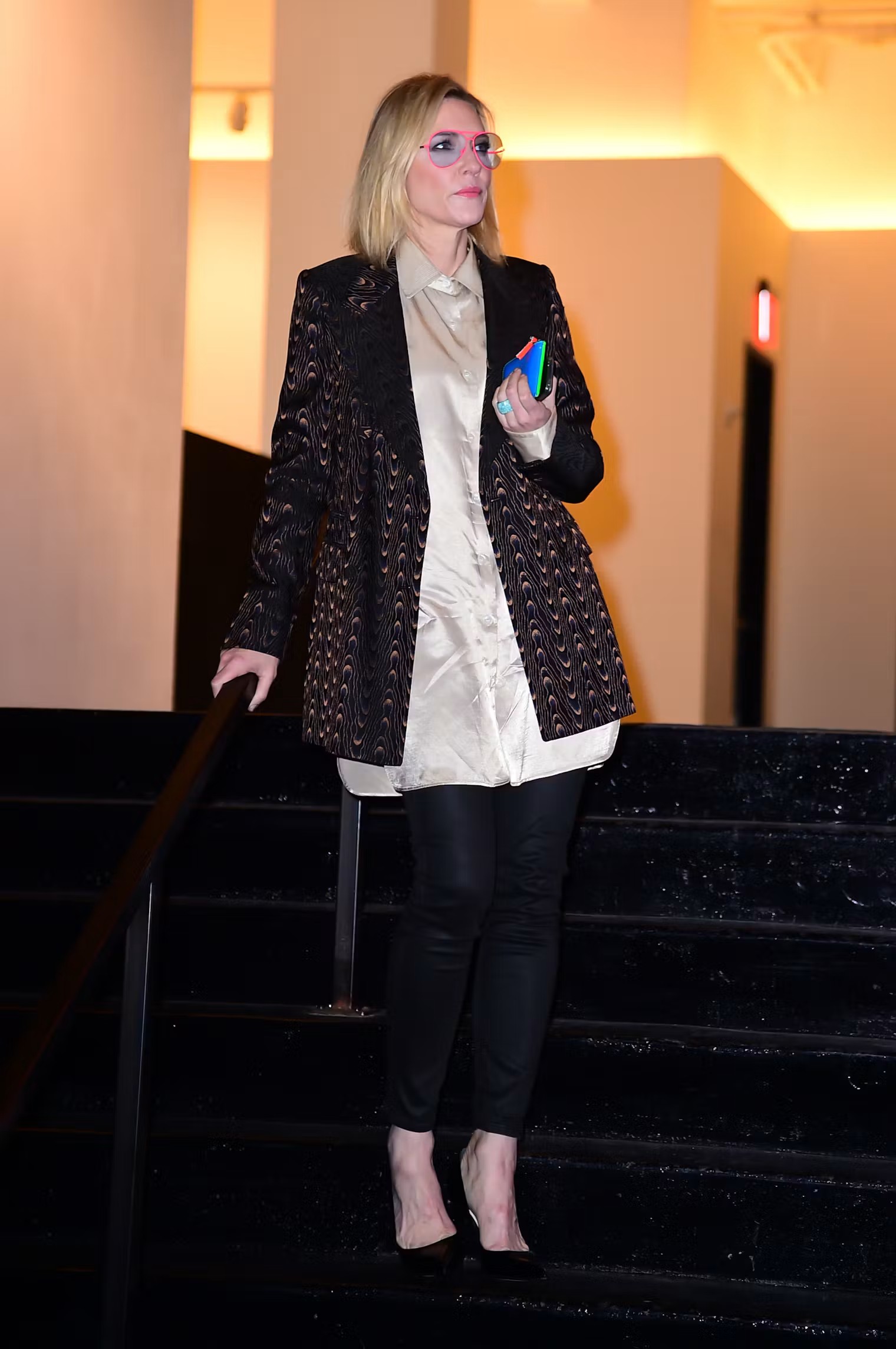
Appearing in London on October 9, Blanchett brought together pieces from different fashion eras in an ensemble that balanced sharp tailoring with an unconventional edge. Tinted hot-pink aviator sunglasses introduced a playful reference to 1980s style, while skin-tight leather trousers recalled the streamlined silhouettes associated with the 2010s. Completing the look was a double-breasted dinner jacket featuring an elaborate, swirling motif that gave the outfit its distinctive character.
The combination was bold without appearing overly constructed. Each element carried its own identity, yet together they created a cohesive expression of Blanchett's personal style. Rather than building an outfit around a single seasonal trend, she relied on familiar pieces and the confidence to wear them on her own terms.
What made the appearance particularly interesting was its history. Blanchett had been photographed in a remarkably similar ensemble in New York's SoHo neighborhood in 2016. A decade later, the look returned with only subtle styling adjustments, demonstrating how clothing can remain relevant when it is not treated as disposable.
Through a contemporary fashion lens, certain elements of the outfit might once have seemed difficult to reconcile. Neon eyewear and skinny leather trousers have both moved in and out of mainstream popularity. Yet Blanchett's approach has never depended on whether a particular silhouette is considered fashionable at a given moment. Instead, she appears to prioritize pieces that suit her personality and can be styled in different ways over time.
_1791645939.jpg)
This consistency has become one of the defining characteristics of her wardrobe. She has repeatedly revisited previous red-carpet looks, including gowns worn to major ceremonies, while finding new contexts for familiar pieces. Her approach challenges the assumption that an outfit loses its value after a single appearance.
The idea is especially relevant in a fashion culture shaped by constant newness. Social media, runway cycles and celebrity coverage can create pressure to present a different look at every public appearance. Blanchett offers another perspective, showing that a personal wardrobe can become more interesting when its pieces are revisited rather than replaced.
Her London ensemble also demonstrated how styling can change the impression of familiar clothing. A tucked-in button-up shirt sharpened the overall silhouette, while her tied-back hair kept attention on the jacket and accessories. Pointed-toe pumps introduced a polished finish, balancing the more unconventional elements of the outfit with a classic sense of refinement.
The result was an example of power dressing that did not rely on conventional businesswear alone. The tailored jacket provided structure, the leather trousers introduced a rebellious edge, and the bright sunglasses prevented the ensemble from becoming predictable. The outfit moved between professional polish, vintage references and contemporary individuality without settling into a single category.
Blanchett's appearance also carried significance beyond fashion. At the festival, she was supporting the Displacement Film Fund, an initiative she founded to support displaced filmmakers and filmmakers whose work meaningfully explores displacement. The fund brings attention to stories shaped by forced migration, instability and the experiences of people whose lives have been disrupted.
That context made her decision to wear familiar pieces particularly fitting. Rather than treating the occasion as a reason to assemble an entirely new look, she relied on established wardrobe favorites. It was a choice consistent with her broader approach to fashion: thoughtful, individual and less concerned with the demand for constant reinvention.
The relationship between style and sustainability is often discussed through materials, manufacturing and the environmental impact of the fashion industry. Rewearing offers another dimension to that conversation. Extending the life of existing garments can challenge the expectation that every public appearance requires something new, while encouraging a more considered relationship with personal clothing.
Blanchett's example does not depend on making a statement about sustainability at every appearance. Its influence lies in the simplicity of the gesture. A well-chosen jacket, a pair of distinctive trousers and accessories with personality can continue to work across years, particularly when they are styled with a clear understanding of proportion and character.
Her look also reinforces the distinction between trend awareness and trend dependence. Fashion trends can provide inspiration, but they do not have to dictate personal choices. A garment that once occupied the center of a particular era can find a renewed place in the present when it is worn with confidence and supported by thoughtful styling.
For Blanchett, the past is not something to be discarded in favor of the next season. It is a resource. Her wardrobe becomes an evolving archive in which familiar pieces can acquire new meaning through different combinations, occasions and cultural contexts.
At the 2026 BFI London Film Festival, she demonstrated that principle with characteristic ease. The outfit drew attention not because every element was new, but because the combination felt personal and assured. A decade after its earlier appearance, the ensemble remained expressive, proving that strong style can survive changes in fashion's prevailing tastes.
Cate Blanchett's latest appearance is ultimately a reminder that lasting style is built through discernment rather than constant replacement. Trends will continue to shift, silhouettes will return and disappear, and the fashion industry will keep searching for the next defining look. But a wardrobe shaped by individuality and confidence can move through those changes without losing its identity. For Blanchett, the most modern choice may simply be knowing what is already worth wearing again.
.jpg)
.jpg)