The objects that define a period rarely tell their entire story. A sculptural lamp, a carefully constructed wooden chair or an intricate wire form can appear to embody the optimism and elegance of modern design. Yet behind these familiar forms are often histories of displacement, discrimination and personal resilience. At the Barnes Foundation, Noguchi to Asawa: Designing Postwar America invites visitors to reconsider the foundations of American modernism through the experiences of six Japanese American artists whose work helped shape the visual character of everyday life.
The exhibition brings together Isamu Noguchi, George Nakashima, Leo Amino, S. Neil Fujita, Kay Sekimachi and Ruth Asawa. Their practices span sculpture, furniture, architecture, graphic design and fiber art, demonstrating the breadth of Japanese American contributions to the cultural landscape of the United States. Rather than presenting their achievements solely through the familiar language of mid-century style, the exhibition examines how their lives and careers were affected by the forced relocation and incarceration of Japanese Americans during the Second World War.
For some of the artists, the upheaval arrived after their professional identities had begun to take shape. Noguchi, Nakashima and Amino were already developing their practices before the attack on Pearl Harbor brought the United States into the conflict. Others were much younger. Asawa and Sekimachi were teenagers, while Fujita was in his early twenties. For several, incarceration camps became places where early artistic training took place under extraordinary circumstances.
These experiences did not produce a single artistic response. Each individual followed a different path, shaped by personal circumstances, professional opportunities and distinct creative interests. Their shared history, however, offers a way to understand the relationship between artistic production and the social conditions in which it develops. The exhibition places their work within the wider history of Asian American life, challenging the tendency to separate celebrated design objects from the experiences of the people who created them.
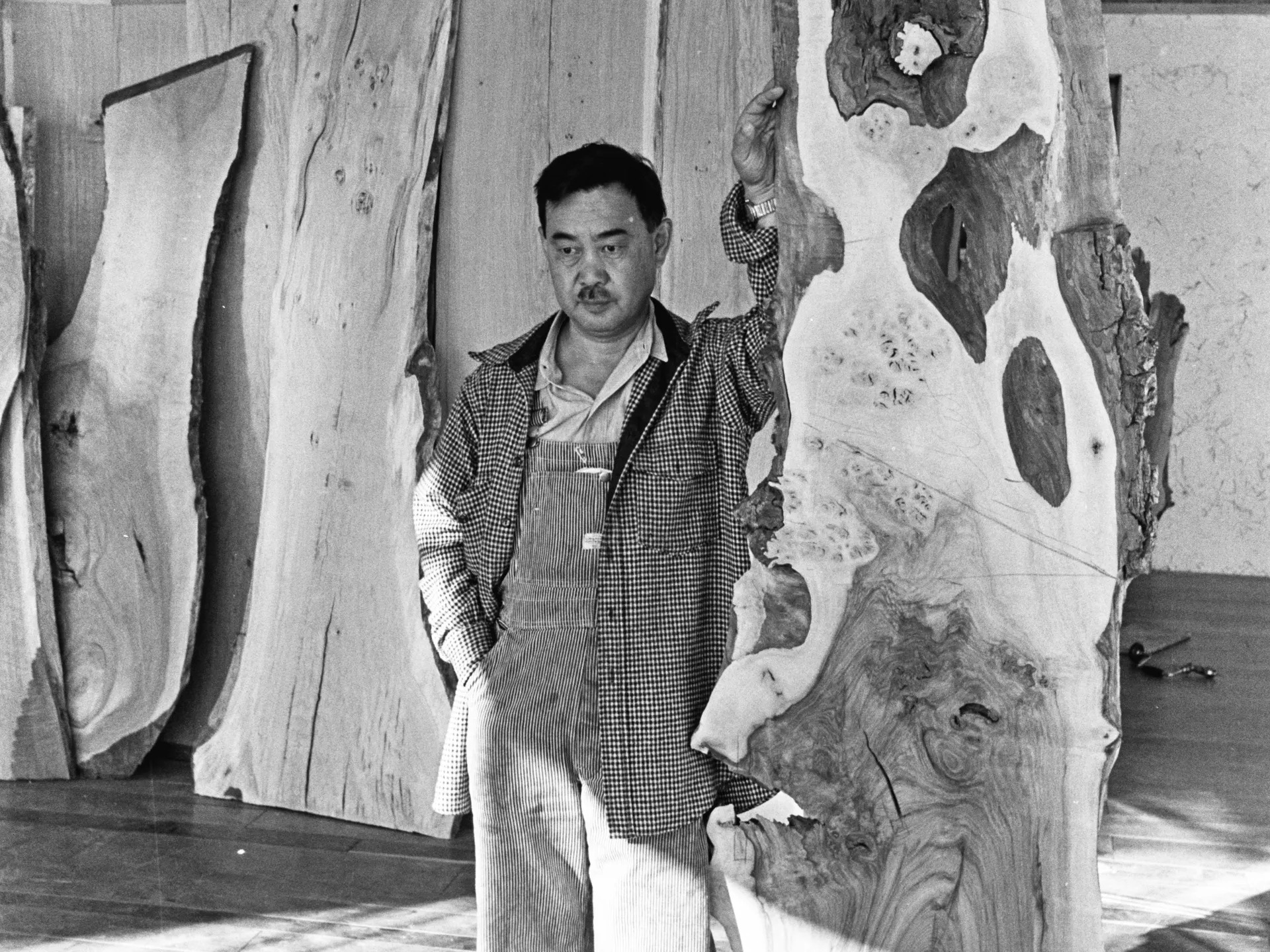
Noguchi’s sculptural approach extended into furniture and lighting, producing forms that became enduring features of modern interiors. Nakashima brought architectural thinking and a deep sensitivity to wood into furniture making, allowing the character of natural materials to remain visible. Amino explored abstraction through sculpture, while Fujita helped transform graphic design through distinctive visual compositions and influential album artwork. Sekimachi developed an expressive language through woven and sculptural fiber, and Asawa became widely recognised for her delicate, interwoven wire sculptures.
Their influence reached well beyond museums and galleries. Their work entered homes, record collections and everyday environments, helping establish the aesthetic vocabulary associated with postwar American life. A lamp illuminating a living room or a chair placed around a dining table could carry the imprint of their creative decisions without revealing the histories behind them. By connecting these objects to the artists’ personal experiences, the exhibition asks visitors to reconsider what is usually understood as a purely aesthetic achievement.
Organised by the Barnes Foundation and curated by Cindy Kang, the exhibition also challenges traditional distinctions between fine art and applied design. Furniture, textiles, graphic compositions and sculptural objects are presented as interconnected forms of cultural expression. This broader approach recognises that design influences not only how spaces look, but also how people live, communicate and understand the world around them.
The historical context gives the exhibition particular significance. The incarceration of Japanese Americans was not an isolated interruption in an otherwise uncomplicated national narrative. Its consequences extended across families, communities and professional lives, leaving lasting questions about belonging, visibility and the treatment of racial minorities. Reconsidering the achievements of these six artists through that history makes their contributions more fully legible, without reducing their work to the hardships they endured.
Ultimately, Noguchi to Asawa: Designing Postwar America offers a more expansive account of American modernism. It reveals how the familiar forms of contemporary life were shaped by artists whose experiences have not always received equal attention in design history. By bringing their work and histories into conversation, the Barnes Foundation demonstrates that understanding an object's beauty can also require understanding the circumstances of its creation. The result is a portrait of modern design that acknowledges both artistic innovation and the resilience behind it.